Showing posts with label family. Show all posts

Wednesday, 2 January 2013

Happy Sixth birdthday Sam

On Jan 2nd 2007 I announced a new arrival into the world on one of the early posts on this blog. I called it Welcome to the World Yesterday was the Sam's sixth birthday and it was a memorable occasion. I think six is an important birthday. As A. A. Milne wrote in Now we are six,

When I was one I had just begun
When I was two I was nearly new

When I was three I was hardly me
When I was four I was not much more

When I was five I was just alive
But now I am six, I'm as clever as clever;

So I think I'll be six now for ever and ever. 
 
 Over Christmas Sam had an insight into the world of growing up from his big Cousins, Jack and Josh, while young Eliot is as yet only just flexing his muscles. Auntie Nina had them all well under control for this Photo shoot.
 

Monday, 12 March 2012

They're never too young

Yesterday our 5 year (two month and 9 day) old Grandson, Sam, held his belated birthday party. The family had been away on Jan 2nd, the actual date, and Sam decided to wait until later to celebrate this ripe old age with his friends.

He decided on an open air celebration which would commence with a nature walk. To try and make it more interesting Simon and I hit on the idea of some simple "work sheets" done like one of the old fashioned I spy books, with just a few pictures with names to fill in.

I did take along a couple of telescopes and these proved a big hit with some of the kids, although I'm not convinced any of the saw what I originally put into view. Nevertheless the sky certainly got a thorough looking at!
The event was held at Hollow Pond, on Whipps Cross Road, which stands at the southern end of what is still called Epping Forest. It is still an interesting green areas where there was quite a lot to see in a good accessible way for the children.

I was pleased that there were more than the expected Mallards representing the Ducks, although this female didn't match the black and white picture on their "work-sheet".

Luckily the male appeared from behind and Island and at times even its eponymous tuft was visible. Every one seemed to enjoy the even, especially when Pam arrived with some hot food, followed by birthday cakes and various other nibbles. I think it's great to start to sow the seeds of some interest in the natural world at an early age, let's hope that Sam's generation are better custodians of their environment than ours has been.

Today I tootled along to the Restharrow Scrape in the hope of seeing the Garganey's that had been present yesterday, but unfortunately they seem to have moved on. Peering through to gloom towards the railway at Mary Bax I eventually found the two Cranes that have been around for a few days. They were not photographable, but through a scope they OK and were obviously very actively feeding in one area. Wouldn't it be great if the work done by the RSPB on their new reserve brought breeding Cranes to Kent, as has been done in Somerset and Norfolk/Suffolk.

Monday, 22 August 2011

The 2011 Birdfair at Rutland

Just back from a long weekend centred round the British Birdwatching fair at Rutland Water.

It was a great weekend that Pam and I spend with Jack, Josh and of course Pete and Nina. Now I am no longer working on a stand all weekend we can spend some of the weekend at Birdfair and the rest doing other things with Nina and the boys, while Pete works on the Birdquest stand. This year we stayed at Lyddington and at the delightful Lyddington B&B.

Not only was the accommodation first class, set in some great grounds but it is situated right next to the Marquess of Exeter, a fine pub with a good restaurant, if a little slow when busy on Saturday night.

I did get a short time to walk round the village, which is one of the most attractive I've seen. Above is Bede House, next to the church and it looks worth a proper visit some time. It is a National Heritage property, so our membership will come in useful.

At the Birdfair, Simon King presided over the British Birds Photographic Awards, and gave his usual enthusiastic appraisal of each of the winners.

For the second year running Pete collected the prize for the best Digiscoped Picture. I must say this is a skill that in the attempts I've made I have completely failed to master.

On the Saturday we had an outing to Barnsdale Gardens. This collection of 38 Gardens was the project of Geoffrey Hamilton, famous for his multitude of TV, Radio and magazine appearances and writings. Each of the gardens shows an individual design for various needs and styles. Jack and Josh found the maze rather to their liking.

A splendid Bronze bust of Geoffrey modelled by his son Chris is in the Memorial Garden. The gardens are now in the safe hands Nick Hamilton, who was on had to answer questions. We met him in the organic vegetable garden, where there were some amazingly large cabbages!

One of the very many stunning arrangements in the gardens.

Ponds always hold a fascination for little boys and it didn't take these two long to find lots of interesting things.
One of the most prised was this Dragonfly exuvia. It is one of the larger hawkers, but I haven't keyed out which one yet.

There were a huge number of Ladybirds around, most were Seven Spot, but this one looks like one of the Harlequin morphs to me.

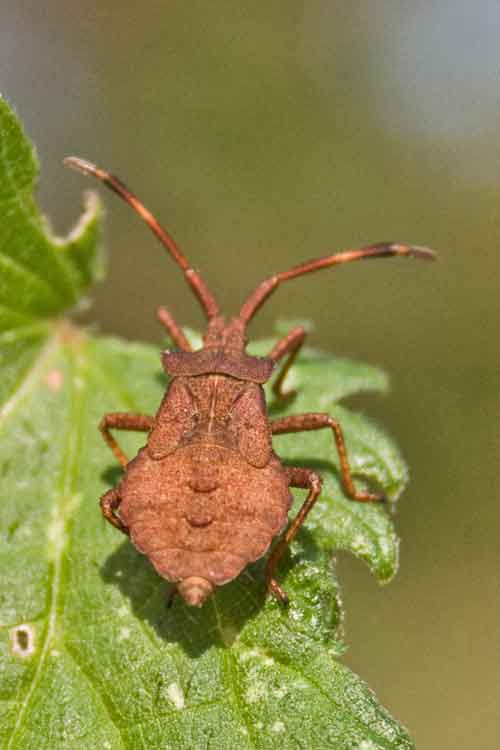
Walking round the gardens at the B&B the keen eyes of the boys soon found some good things to look at. W saw a Brown Hawker and a few Butterflies, but this bug was a little more unusual. I think it is call Coreus marginatus. The larvae feed on the seeds of plants in the dock family (Polygonaceae).

From be end of the B&B grounds there were good views over the rolling countryside. We saw two Red Kites and later six Common Buzzards were out in the recently cut fields, presumably finding rodents that were out there feeding on the dropped seeds.

A walk from the Osprey Centre did give some distant views of the female of the pair. She was sitting on a post and failed to give us a flying demonstration. Still it was good to know that they had reared three young. Hopefully I'll be seeing them as the migrate over St Margaret's alter in the year. Jack and I also got a fleeting view of a Kingfisher as it left one of the pools in front of a hide where we were told it had been on view.

Overall it was a great week end. Meeting old friends, spending time with the family and catching up on various things going on, not only in the birding world but also in other areas of natural history. As usual the Art Marquee drew me back several times, where the standards of the work exhibited was, as always superb.


Monday, 3 January 2011

Happy Fourth Birthday

After only a couple of months of blogging I welcomed Sam, then our youngest grandchild into the world on January 2nd 2007. It really doesn't seem possible that the time has flown by so quickly.

Yesterday we spent a happy time helping Sam celebrate his birthday. No longer the baby of the family, he has handed that privilege to his brother Eliot.

I don't know what Sam wished for when he blew out his candles, and it was the two Ronnies time, fork 'andles, but with all his presents at Christmas and now his birthday he has doing pretty well.

Thursday, 30 December 2010

Spanish Flu!

We spent from the 22nd to 29th December in La Linea de la Concepcion. La Linea, as it is generally known is on the main land side of the line that separates the British overseas territory of Gibraltar from Spain.

We left from Luton in snow, and we were lucky that our take off was only delayed by two hours 45 minutes. We were even luckier that our plane landed in Gibraltar as scheduled, all others that day were diverted to Malaga due to high winds, we go in during a short lull. The view from the hotel window over looked on of the marinas and I had lots of views of Yellow-legged Gulls and Shags roosting out in the harbour. The focal point of the trip was Eliot's (our youngest grandson) baptism on Boxing day, but of course we had a great time with Rocio's family with meals on Christmas Eve, and Christmas Day. Unfortunately the last few days were somewhat subdued for me as I developed what I presume was some sort of flu. I got through the Boxing Day formalities, and family party, but then spent much of the last three days in bed asleep.

A large wet area along side the road hosted various birds when I had a look round. There were several Black Redstarts, one of which did pop onto our balcony wall one day, but didn't hang around for long. They seem to be quite common in any open piece of ground in the town.

White Wagtails were also prominent, both in the wet areas and on the roofs of the town buildings.

Of course if you've go Black Redstarts you also have to have an ugly fence for them to perch on!

The rock had hundreds of Yellow-legged Gulls circling the peak. Unfortunately at this time of year they aren't joined but groups of migrating raptors and storks.

Any Larophile can study the various age plumages of Yellow-legged Gulls for the cafe at the top of the cable car.

The views from the top are quite spectacular. I hadn't really appreciated quite how much development there is on Gibraltar until we were able to look down from the top.

The runway juts out into the sea on both sides of the rock. Behind it you can see the marina and our hotel.

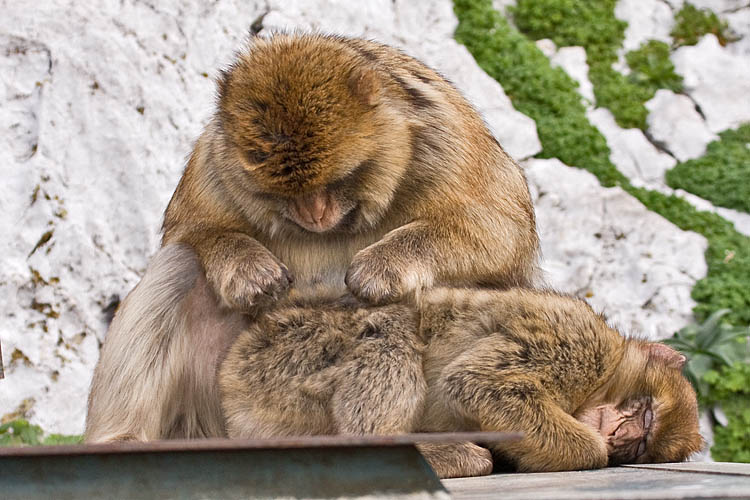
You can't go to Gibraltar without going to see the Barbary Macaques. It is the only population of these monkeys on mainland Europe. There is a population of about 230 animals in five troupes. As they are a tailless species, they are also known locally as Barbary Apes or Rock Apes, despite the fact that they are monkeys (Macaca sylvanus).

Like all monkeys grooming plays a major part in their social activities. They are of course habituated to people and this leads some people to act very stupidly, despite the warnings. They can be quite viscous and will inflict nasty bites.
All Gibraltar Barbary Macaques are descended from North African populations of Barbary Macaques. DNA evidence has established beyond doubt that the present population of Gibraltar macaques is of relatively recent Algerian and Moroccan origin. No traces were found of a third source for their DNA, namely of any ancient, no longer surviving Iberian population. An earlier theory, now dis-proven by the DNA evidence, was that the original Gibraltar macaques were a remnant of populations that had spread throughout Southern Europe during the Pliocene, up to 5.5 million years ago.
The original introduction of the macaques was probably by the Moors (who occupied southern Iberia, including Spain and Portugal, between 711 and 1492) for use as pets.

Saturday, 18 December 2010

Aerial Landing

We have made a trip up to Clitheroe this weekend. It has a duel purpose, first to see Josh, and help him celebrate last weeks seventh birthday, and second, as we are going to be in Spain, with Simon, Rocio, Sam and Elliot over the next week, as our Christmas visit.

We travelled up relatively easily, with cold weather but very little snow. That all changed last night and we woke up to a white landscape. A call from Mike Watson let us know there were a group of Waxwings in town.

They were right on the main road leading into the centre of town, and when disturbed the moved of a hundred yards or so and rested in a tree in a quieter spot.

On of the locals also told us that they visited an apple tree nearby, but when we looked the sole occupants were a couple of black birds taking advantage of the fruit left hanging on the tree.

On their way back to the ornamental Rowan type tree the paused to view the area from a television aerial. Altogether there were fifteen, and they were quite vocal. Seeing a group of birders several locals did stop at ask about the birds, and as usual were stunned at just how beautiful these visitors that they hadn't noticed were.

While the waxwings were a way two backbirds took advantage in the vacant feeding station and had a quick bash at the berries.

Back at home (for Jack and Josh), they'd added a suet block feeder to the array of food available. Jack is hoping that a Great Spotted Woodpecker to take advantage of it, but so far it has been mainly Starlings with a least one Blue Tit. Hopefully a Woodpecker might visit tomorrow.

Sunday, 24 October 2010

Master birder and Apprentice

The Clitheroe branch of the family were lucky enough today to enjoy a beautiful autumn day and some great birding as well.

We started by visiting Pegwell Bay and were there in time to watch the tide sweep up the beach, bringing many of the birds into much closer range. Others went out to Shellness Point and were swallowed up in the mass of Oystercatchers already assembled there.

The Lapwings, on the flood in front of us, along with Redshank and a few Golden Plover (noon in the group above) soon decided to move on to a drier resting place.

A few Curlews dropped into the long grass and soon disappeared. I suppose with a full moon it was quite a big tide. We didn't wait too long as we wanted to get along to North Foreland.

Jack is learning to look like a birder, with his scope slung over the right shoulder. Here he's striding out just like Dad.

As we walked back to the car park there were several Reed Buntings in the bushes, probably displaced from feeding on the salt marsh by the rising tide.

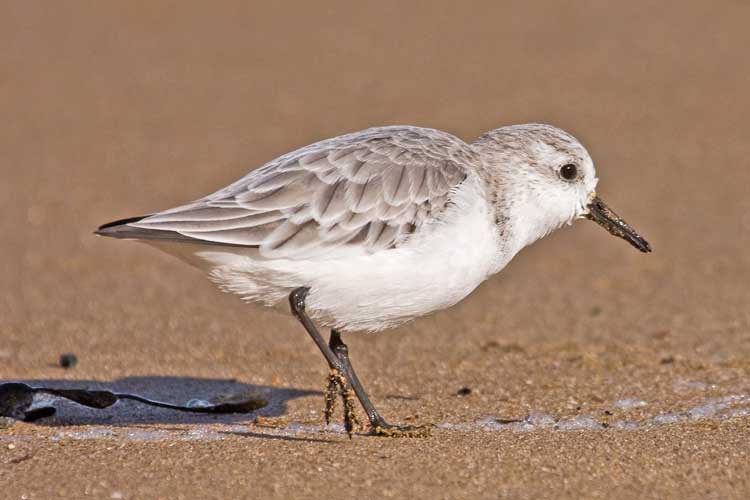
At Kingsgate Bay we caught up with a couple of Jack's targets that were giving excellent views. Although a common visitor on sandy beaches it is impossible to tire of watching target number one, a group of Sanderling feeding on the shore line.

Higher up the beach there were several Pied Wagtails enjoying the insects that inhabit the washed up sea-weed.

The second target was Purple Sandpiper, and although not present in the same numbers as the Sanderlings. two were to be found at the north end of the bay, mixing with a group of Turnstones.

As the waves came in the Sanderlings ran up the beech, each looking as if it was on little clockwork legs. Some of the Turnstones seemed to join in the fun and ran along side the Sanderlings although they were never quite so robotic.

As the groups reach as far up the beech as is necessary to avoid the on rushing water, there is a pause, before they turn round and run back down the beech to feed on the sand that has just been covered. Here they must find small tit bits that have been left by the retreating water.

This group appear to be waiting in eager anticipation, peering into the sea, hoping to find a newly arrived delicacy.
I only saw one Rock Pipit on the beech here, but there were probably more around. After seen Water Pipits at Grove Ferry yesterday it was interesting to see just how different they are.

Sanderlings breed in the high Arctic, and have a circumpolar distribution. It is a long distance migrant with a widespread distribution in winter, with some migrating to South America, Southern Africa and Australia, while others remain in southern Europe.

Kingsgate Bay was a success with everyone, as well as enjoying the birds Josh collected a few interesting items form the beach, including at least two different sorts of Mermaid's Purses. These are the egg cases from Dogfish and other small "Sharks" and from various species of Skate. I think that one that Josh found was from a lesser-spotted Dogfish, but we haven't yet identified some smaller ones that were in groups.