
Another fine day, and I hoped another opportunity to photograph the Ring Ouzel in the Paddock, if it was still there. As I was walking towards the gate of the Paddock I met a couple who said they'd been round, but not seen a Ring Ouzel, however at that point Colin Sumner appeared and told me he'd just been watching it near Mc Swiggans. We walked over there but failed to find it, and I was just about to leave, to walk round the farm, when it caught my eye, flying into a bush.
 The couple I'd been talking to had left by now, but I managed to get reasonably close and took a few photos.
 It was soon off and disappeared into the hedge on the farm side. As it obviously liked feeding on the short grass, "mowed" by the ponies it seemed a good idea to sit under a bush and hope that it would return.
 There were still birds to watch, particularly the various finches, and of these most prominent were a group of Linnets. They seemed quite quiet last week, but the warm weather seems to have made the very active now and the males were singing well from their watch points while the hens got on with the business of home making.
 My patience was rewarded and the Ouzel returned to feed on the turf. At first it was almost into the sun and the light was harsh. I did get some pictures of it with a worm, but it was an unsatisfactory angle. By walking a wide circle I managed to encourage it to move to a better position, and then I walked back behind a bush, sat down and slowly shuffled forward, never mind the pony poo, until I was in line for it to move into my vision, in better light.
 It worked well, and soon it was on the slope not too far away, and seemingly taking no notice of me. It seemed to be finding worms very easily and it had quite a battle getting this one out of the ground.
 When it finally got it out of the ground you could imagine that you could hear a pop as the worm came out and the Ouzel almost fell over backwards. It seemed to mess around with the worm for some time.
 In this picture it appears to be doing the Indian Rope Trick, with the worm standing vertically with no visible means of support.
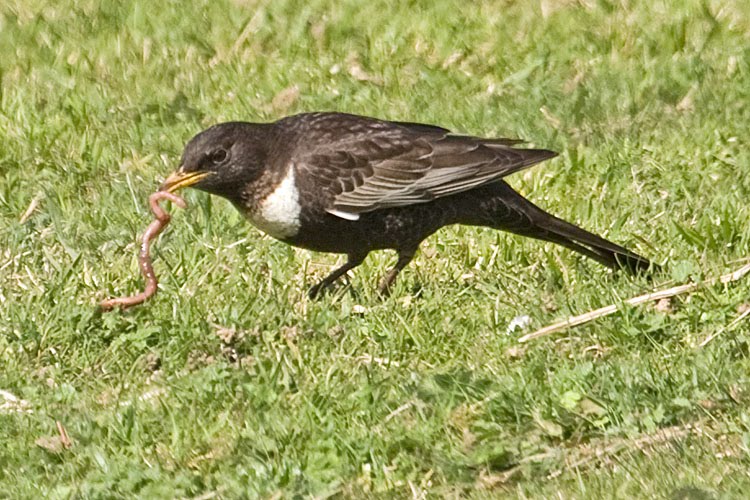 The bird got a bit closer and caught yet another worm, and I noticed that the battery symbol was flashing almost flat on my camera, and to compound it, I'd left my bag next next to the bush I'd started at, and the Ring Ouzel was right next to it.
 I did get a couple more shots before the battery gave up completely and I them had to wait for the Ring Ouzel to move before getting a charged battery.
 All the time I'd been watching the Ring Ouzel a pair of Long-tailed Tits had been flitting passed me as I sat on the ground. They seemed to be collecting feathers and then vanishing into the hedge.
 I'd seen them in this area before, and if they were collecting feathers they should be getting close to finishing their nest. Once I was free to have a look, I carefully peered into the hedge, without touching it, and was surprised to see a beautiful globe of moss, lichen and cobwebs quite close to the front of the bush. Hopefully it is well enough hidden from any predators, but I did find it very easily. I will keep an eye on it and hopefully in a few weeks time they will have a brood fledged and easy to watch.


