Friday, 17 May 2013

A long time ago!


Exactly forty-eight years ago today, in the early evening,.Pam and I arrived at the Church Hotel in Edale, Derbyshire, after a train journey from Manchester.

This was after a lunch time ceremony in St Anne's Church in the centre of Manchester where we started our marriage.Obviously, starting as I meant to continue, Pam, carried the cases.

I did let her do a bit of map reading, but of course the Peak district can be a bit difficult and we all know the problems of letting the wife do the navigating.

We did manage some good walks, and found Twite and Redstart, and all in all Pam had a good introduction to the problems of living with a birder. Well that's what Honeymoons are for, isn't it! (yes, I know I only look 12, but it's just a trick of the light). In spite of this warning we are still together, what fortitude my wonderful wife possesses!

Wednesday, 15 May 2013

A post for Derek!

In the last post I was excited about the comings and goings of a couple of Hobbies and a kestrel. As an after-thought I put in a picture of a Grey Partridge. Regulars at Sandwich are lucky, in that these birds are often prominent along the Ancient Highway, and using a car as a hide, they often come very close as the feed in the meadows.

Derek Faulkner commented that it was the Grey Partridges that impressed him most as they are now an uncommon sight on Sheppey (home of Derek and the prison). I thought I'd put few more pictures up of this delightful species. Not a member of the gaudy brigade but subtly very beautiful. The chestnut horseshoe mark on the belly is often hidden as the bird keeps low in long grass.

This one was showing off to what I though was another pair, but it may have been two females, since they both squatted down at this territorial display.

Fences are a big problem, in that they are rather intrusive in the picture. Even if you manage to focus between two wires, there is often another one in the background.

It was good to get one close enough to see the eye colour clearly. The bill is mainly used for collecting plant material, although occasionally insects are taken, especially by the female when feeding young.

The barring of the coverts and scapulars was worth a close up. as can be seen in the second photo, the long scapulars can be fluffed out when displaying.

Monday, 13 May 2013

Making a viewing point out of a Mole Hill

Not only is the spring late and the weather awful, I was away when many of the migrants that have arrived or passed through did so. Therefore, rather late this was my first Common Sandpiper of the year

t

At the same time the Reed Warblers singing in the ditch behind the Hide at the Restharrow Scrape were also new for the year. Water in the scrape has dropped by about six inches since last week.and this could have an architectural consequence

.
Last week the House martins were collecting from the sandy island at the far end of the scrape. The mud here is much darker and may well give rise to two tone nests on the estate.

As I drove along the Ancient Highway I watch a Hobby zooming passed and then just after Willow Farm I noticed a lump sitting on top a a mole hill, and that seemed to be a continuing theme. The distances were quite large so I apologise now for the photos, but I thought the story worth telling.

There were at least two Hobbies around, and I suspect that they were fairly newly arrived and hadn't yet been given the route to Grove Ferry and Stodmarsh.This ones not actually perched on the cows nose, but another mole hill!

Most of the time I was watching they only took short low flights around the filed and I didn't see them catch anything, although it may be they were using the mole hills to find invertebrates on the ground.

There was something very "English Countryside"about this bucolic scene, but it's one that wouldn't have been possible twenty years ago, when Hobbies were still quite scarce in Kent.

This one had just move to what was obviously an extra attractive molehill, and had settled down for a preen and general chill out.
Then  another falcon caught my eye, at first expecting a second Hobby I was surprised to see it was a Kestrel and that it was making straight for the Hobby.

There was little doubt as to who was the aggressor in this confrontation, although to be fair the Hobby showed little reaction at first.

 For a while they sat there staring at each other, the Hobby somewhat perplexed that his presence had caused such a reaction from the locals. In the end he flew a short distance to the next mole-hill. At this point I did wonder if the Hobby had indeed found a prey item because the Kestrel seemed to be picking something up from where the Hobby had been,

While I'd been watching this a pair of Grey partridges had been quietly gewtting on with their business, presumably neither of these two small birds of prey offer any threat to them.

Saturday, 11 May 2013

Keep a' Knocking but you can't come in!

For the past three mornings I've been woken up at a ridiculously early hour by a banging on the window.  The first time it happen I really didn't know what was going on, and jumped out of bed to find out who or what was the cause of the commotion.


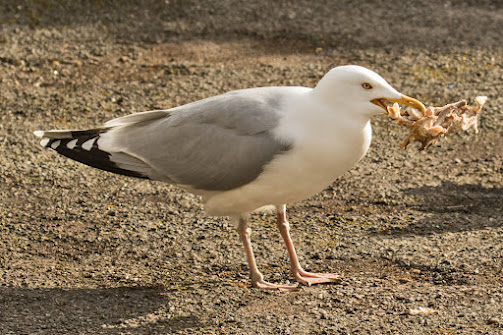
You can imagine my surprise to find Mr and Mrs Herring Gull, perched on the ridge of our dining room roof, the male looking intently into the window and hammering for all he was worth. Whether this was nosiness or the window was acting as a mirror I don't know. Yesterday the alarm call came at 4.51 am. This morning I was not so inconvenienced. I still had the ear plugs that failed to get me a nights sleep on the plane back from LA and this time they were far more successful..I don't know where this pair is thinking of nesting, but they seem to have something of this ilk on their minds as they spent yesterday afternoon doing what comes naturally on next doors roof. I was a little surprised, as when I've observed other species of birds mating the act is usually over almost before it started, but this chap had a lot more stamina and did his species proud. I am not too happy that they might try and nest on out chimney as they do seem to cause problems when they nest on houses, perhaps a gentle pointer towards the cliffs might induce them to move to more natural surroundings.

Friday, 10 May 2013

On the Beach again

Gulls and Terns are unique families in that they can be found on every continent in the world. They also have a basic pattern that with just a few exceptions is recognisable which ever species you're looking at. In the main they are grey above and with below. The above colour can vary from almost black to almost white (or in one case completely white). the general theory is that this pattern makes them difficult to see from above as far as predators are concerned and difficult to see from below, as far as prey is concerned.

 Of course when you find gulls on a beach half way round the world the odds are they are different species to the ones you see at home. But even in Los Angeles two of them, one gull and one tern, were species that I've seen in Kent! Not the Western Gull above though, this Herring Gull sized bird is strictly a west coast of North America bird. It does wander up to Alaska and down to Mexico sometimes, and occasion visits some of the inland states, but compared to many gulls it isn't very much of a traveller.The dark grey mantle is similar in colour to out Lesser Black-backed Gull, but they are unlikely to be met with together!

Above two Western Gulls share the beach with at California Gull, a smaller gull, about half way in size between a Common Gull and a Herring Gull this bird winters on the West Coast of N America, but moves inland to breed in land on lakes from Canada down to Utah. The largest colonies are in Great Salt, Utah and Mono Lake, California. There are now around 200,000 pairs in total, but in 1930 they were down to 50,000 pairs due to egg collecting. Vagrants have occurred in Japan and Hawaii as well as on the American East Coast

The Ring-billed Gull  has occurred in Kent, and one must beware on on-coming motorbikes when twitching one (Barry!). This is the most frequent N American Gull to visit Europe and has been recorded in many countries, with gatherings of up to 17 seen in Ireland. It is a little bit larger than a Common Gull which is a potential confusion species. I breeds across N America on fresh water lakes, and with a population of up to 2 million pairs and a migration the takes some of the population down to the Caribbean the potential for vagrancy, helped by late summer hurricanes is obvious.

The wing pattern of this late first winter/first summer plumaged bird does show some similarity to a Common Gull, so care is needed in identification.

A nice group of three species of terns with two California Gulls. 

Two Caspian Gulls, another species with a large world wide distribution. Dungeness has hosted one that I saw and is probably the most likely place in Kent to turn up another of this jumbo sized tern.

Elegant Terns breed along the Pacific Coast, from Southern California to Central America. It has been recorded in Europe a few times, including one breeding with a Sandwich Tern in France. On average it it just slightly larger than a Sandwich Tern, but with the long crest and distinctively curved bill a good view should be conclusive. One at Dungeness would cause some excitement!

Another big Tern, almost the size of a Common Gull, the Royal Tern has two subspecies. One that breeds on both the east (includig the Caribbean) and west coasts of North America and one that breeds in West Africa. Occurences of large terns with orange or red bills nearly always cause confusion and debate, ofteen because the views are brief and distant. This bird is in first summer plumage, adults have a black cap and nuch paler primaries.

Wednesday, 8 May 2013

A Little Beauty!

As I approached the old barn at Willow Farm I could see the silhouette of a little Owl on the far side. When I'd past the barn and looked back it was in full view. At the Restharrow Scrape hide there was little to see at first and I told Steve Ray, who'd just arrived that the Owl was in its usual place. I was surprised when he told me that it was never there when he looked for it, he must choose the wrong moments to look.

 At that moment I saw a Lapwing on the far island chase something to the back and out of sight. My impression was of a small wader but I didn't get it in my binoculars, so it was a wait until, the aggressive Plover chased it again. This time it flew to the nearer island, but landed out of sight. Watching in flight I was pretty sure it was a Stint, and probably a little. This was confirmed when it came into view and then, nudged by the resident Lapwing it joined us on our side of the water for a couple of minutes.

 As I've said before, I love waders and this sparrow sized calidrid is almost as good as it gets. They breed right up in the Arctic zone, from northern Sweden across to beyond the Taymyr Peninsular and to the New Siberian Islands (I can't spell the Russian name for these). In winter they move to temperate and tropical climates from the Mediterranean, through Africa, the Middle East and the Indian Sub-continent.and Burma. Some remain in SE England, foolishly believing our climate to be temperate!.

 It wasn't in complete summer plumage, the face and upper breast is yet to get its buffy orange colour.

 The beautiful chestnut fringing of the coverts, lower scapulars and tertials showed up well.

 Unlike the Temminck's Stint the Little Stint has black legs. There are four small calidris waders with back legs, the two Americans, Western and Semi-palmated. Both are slightly larger and both have partly webbed feet that would show up on the picture above. The fourth is the Red-necked Stint, which by now would be showing a reddish upper-chest and a freshly moulted bird would have a much greyer mantle.

 After the Stint had departed the previously aggressive Lapwing came over to the edge in front of the hide and worked along the edge picking tit-bits out of the mud.

On my way back I noted that the Owl was still in place.nicely framed as he dozed. I wonder if it was there when Steve passed?

Calling out your name

A good start to the day with a few more moths to verify that the warmer nights were at last having the desired affect and encouraging a bit more activity in the night air.

The highlight of another glorious afternoon and a walk along the cliff top from the South Foreland Valley to Langdon Hole was the evocative cries of a group of Kittiwakes loafing around on the sea just down from the Lighthouse.
Altogether I counted 42 Kittiwakes below me, but I must admit I may have missed a few as looking over a cliff top with drop of around 100m! Not a common breeder in Kent, probably due to lack of suitable breeding sites the Kittiwake, or more properly the Black-legged Kittiwake (to separate it from its Red-legged congener from Alaska) is the most numerous gull in the world.

The number of Kittiwakes breeding on the cliffs here has certainly fallen over the years. I find it hard to see where there are appropriate ledges now, but it isn't easy to see the face from the top. I'm hoping for a boat ride from the Bay to Dover later in the summer to try to see and nesting activity.

As well as the large flints jutting out from the chalk there are also large faces that have a sort of bumpy "marbled" effect. Again there don't look to be many places to lay an egg on these areas.

As I looked over the top I noticed this chap collecting something, presumable shellfish of some sort, either for human consumption, or possibly as bait when fishing. At Langdon Hole a Lesser Whitethroat was singing from the scrub at hte bottom, but I was too lazy to go dawn there to see the bird. Back towards the Lighthouse numerous Linnets were feeding in the rough grass now set aside from the agricultural fields and one Corn Bunting repeated his jingle several times from a fence post.