Showing posts with label Grey Partridge. Show all posts

Thursday, 18 January 2018

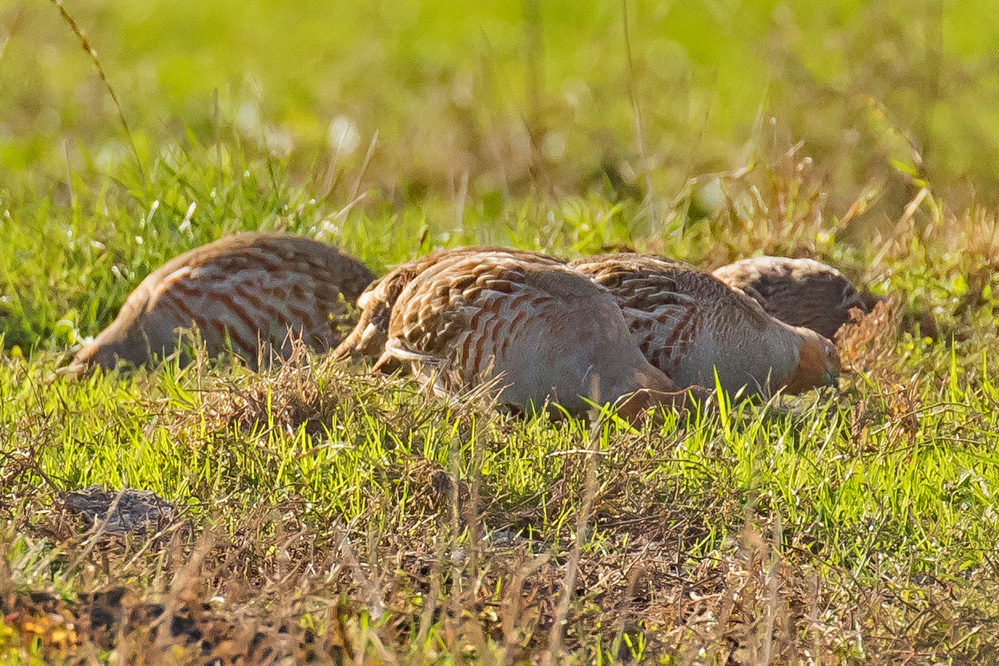
A covey in the sunshine.

There are few more unassuming, quite and yet beautifully subtle birds in the UK than the Grey Partridge. Unfortunately to some it is still a bird that should be shot for fun. It has become quite a rare bird, but fortunately in our part of the county I can almost guarantee and encounter with a little bit of searching.

Part of the covey of about 10 birds.


Wednesday, 19 October 2016

Moving Lumps on the ground.

The last week hasn't been good. A bad dose of something very nasty has had me in bed, or at least in doors in the smallest room, for most of the last seven days, I did manage to get to the Kent Wildlife Conference at Kent University, and with the help of heavy dosing and crossed fingers, I got through my talk on Kent's changing birds, over the period I've been birding, with out accident.


A view from the lounge window. Apart of the flock of Goldfinches feeding in the garden. These are under the feeders below the grape vine.


When I counted these I was surprised how many there were on the ground, As this is just one of two feeding areas the total flock in the garden is now approaching 200.

Yesterday I managed an exciting trip to the pharmacist, and took the opportunity for a drive from Deal along the Ancient Highway.

 I noticed some lumps on the ground. While thousands of Red-legged Partridge infest the countryside, waiting for the unspeakable to blast them out of the sky, some native Grey Partridges keep their heads down, on Worth Marshes.

They are one of my favourites and we are lucky to see them regularly here.


Tuesday, 3 June 2014

A leopard in the grass

During the School half-term Nina, Jack and Josh came down from Clitheroe for a few days. Pete was away taking a group round China, hard life isn't it, and we had a couple of days trying to see as many of the orchids that wereout in Kent as possible. We managed a creditable 14 species, which was pretty good going.

At one site there was an unusual Southern Marsh Orchid,  Var. junialis  known as "Leopard marsh Orchid". At the time the leaves were visibly very different but the flower was only just beginning to open. Today it was fully out and a very stunning orchid it is.

At one time this variety was thought to be a variation of a hybrid between Southern Marsh and Common Spotted  Orchids, but the fact that they were found in colonies with no Common Spotted suggested otherwise. The fact that it is a variety of Southern Marsh Orchid is supported by genetic evidence.

While I was photographing the Orchids a Common Whitethroat accompanied me with its scratchy song. Although they have never fully recovered their numbers from the great population crash of 1968/9 they are very much more numerous than for many years in the later part of last century.

It is always worth looking carefully from the Ancient Highway form Grey Partridges. The meadows here are the best I know for watching this beautiful native species feeding out in the open.

I hadn't seen the Little Owl perched on the old barn opposite the Chequers for a while, but it was sitting in the sunshine today.
While I was watching it had a good preen and got into various contorted positions while it had a scratch.

Saturday, 15 March 2014

It's a bit of a Lark

I caught up with the two Shore Larks on the beach, near the Chequers Pub along the Ancient Highway today.

They were quite elusive, and were best visible when standing on top of the ridge silhouetted with the misty sea in the background. I took this one, from behind as it will probably make an appearance in a future quiz.

Nice and easy to sea what it is when it turns its head. The foot path along the the beach top was reasonable busy with walkers and these two were quite wary of close approach, hence the rather distant pictures.

Shore larks are extremely widespread and there are a large number of subspecies, anything from 37 to 50 have been postulated. The race that we get here is  Eremophila alpestris flava. They migrate south from Scandinavia.

 Recent work has shown that there may be several species,at the moment six, but that includes just one for north America, where there are many sub-species and further work is still needed.

g
 The two birds often disappeared over the ridge and after waiting for then to reappear I would fin that they'd craftily move 30 or 40 yards and left me waiting for nothing.

 This one had a will marked facial mask and almost flew towards my as I lay among the wet pebbles and various bit of flotsam and jetsam hoping it would walk up to me.

 This is an American Horned Lark, (one I took in April last year in Colorado) but I'm not sure which of the subspecies. If the splits that have been recommended in the scientific paper are accepted this will be Eremophila alpestris and the one in Northern Europe Eremophila  flava. I did have a look at the paper, it's called "Limited Phylogeographic Signal in Sex-Linked and Autosomal Loci Despite Geographically, Ecologically, and Phenotypically Concordant Structure of mtDNA Variation in the Holarctic Avian Genus Eremophila" The authors are from Russia, Serbia and Norway, but it could be in double dutch as far as I'm concerned. The science of DNA is way beyond me!

I was pleased to see a couple of Grey Partridges in the field next to where I'd parked my car. We are lucky here, in many places they are not so easy to find.

Wednesday, 15 May 2013

A post for Derek!

In the last post I was excited about the comings and goings of a couple of Hobbies and a kestrel. As an after-thought I put in a picture of a Grey Partridge. Regulars at Sandwich are lucky, in that these birds are often prominent along the Ancient Highway, and using a car as a hide, they often come very close as the feed in the meadows.

Derek Faulkner commented that it was the Grey Partridges that impressed him most as they are now an uncommon sight on Sheppey (home of Derek and the prison). I thought I'd put few more pictures up of this delightful species. Not a member of the gaudy brigade but subtly very beautiful. The chestnut horseshoe mark on the belly is often hidden as the bird keeps low in long grass.

This one was showing off to what I though was another pair, but it may have been two females, since they both squatted down at this territorial display.

Fences are a big problem, in that they are rather intrusive in the picture. Even if you manage to focus between two wires, there is often another one in the background.

It was good to get one close enough to see the eye colour clearly. The bill is mainly used for collecting plant material, although occasionally insects are taken, especially by the female when feeding young.

The barring of the coverts and scapulars was worth a close up. as can be seen in the second photo, the long scapulars can be fluffed out when displaying.

Monday, 13 May 2013

Making a viewing point out of a Mole Hill

Not only is the spring late and the weather awful, I was away when many of the migrants that have arrived or passed through did so. Therefore, rather late this was my first Common Sandpiper of the year

t

At the same time the Reed Warblers singing in the ditch behind the Hide at the Restharrow Scrape were also new for the year. Water in the scrape has dropped by about six inches since last week.and this could have an architectural consequence

.
Last week the House martins were collecting from the sandy island at the far end of the scrape. The mud here is much darker and may well give rise to two tone nests on the estate.

As I drove along the Ancient Highway I watch a Hobby zooming passed and then just after Willow Farm I noticed a lump sitting on top a a mole hill, and that seemed to be a continuing theme. The distances were quite large so I apologise now for the photos, but I thought the story worth telling.

There were at least two Hobbies around, and I suspect that they were fairly newly arrived and hadn't yet been given the route to Grove Ferry and Stodmarsh.This ones not actually perched on the cows nose, but another mole hill!

Most of the time I was watching they only took short low flights around the filed and I didn't see them catch anything, although it may be they were using the mole hills to find invertebrates on the ground.

There was something very "English Countryside"about this bucolic scene, but it's one that wouldn't have been possible twenty years ago, when Hobbies were still quite scarce in Kent.

This one had just move to what was obviously an extra attractive molehill, and had settled down for a preen and general chill out.
Then  another falcon caught my eye, at first expecting a second Hobby I was surprised to see it was a Kestrel and that it was making straight for the Hobby.

There was little doubt as to who was the aggressor in this confrontation, although to be fair the Hobby showed little reaction at first.

 For a while they sat there staring at each other, the Hobby somewhat perplexed that his presence had caused such a reaction from the locals. In the end he flew a short distance to the next mole-hill. At this point I did wonder if the Hobby had indeed found a prey item because the Kestrel seemed to be picking something up from where the Hobby had been,

While I'd been watching this a pair of Grey partridges had been quietly gewtting on with their business, presumably neither of these two small birds of prey offer any threat to them.