A few shots of the Bay when Gertrude came to visit, a couple of days ago.
This is a small village near Dover in Kent. My intention is to show some of the Village, its history and the wildlife I find there.
Showing posts with label sea. Show all posts
Friday, 5 February 2016
Monday, 30 November 2015
Oh! I do like to be beside the seaside
It wasn't an inviting afternoon, but I decided to have a look at St Margaret's Bay around High tide, as there are normally lots of Rock Pipits forced up there, at this time. In addition, the fact that the direct road down to the bay was closed for road works would probably mean there would be fewer people down there.
Since the car park was renovated a few years ago it does provide nice muddy pools for wintering Pied Wagtails to pick around looking for morsels to eat.
There were at least two Pied Wagtails using the puddles that were sheltered by the wall of the car park, almost as if it had been designed for them.
The search finally paid of and this Wagtail popped up with a large caterpillar. It took a while beating on the ground, but it did disappear in the end.
After such a large meal the Wagtail settled to an afternoon dose, although I suspect it would be looking for more quite quickly.
The thoughtfully constructed fresh water lake in the car park (providing we get enough rain) was in full use by some Black-headed Gulls.
All of those present today were winter plumaged adults and disappointingly they were not joined by any more interesting Gulls.
This, a second bird seemed happy running along the wall, unperturbed by the conditions.
There were quite a few Herring Gulls around, some occasionally making use of the damp grass to look for food.
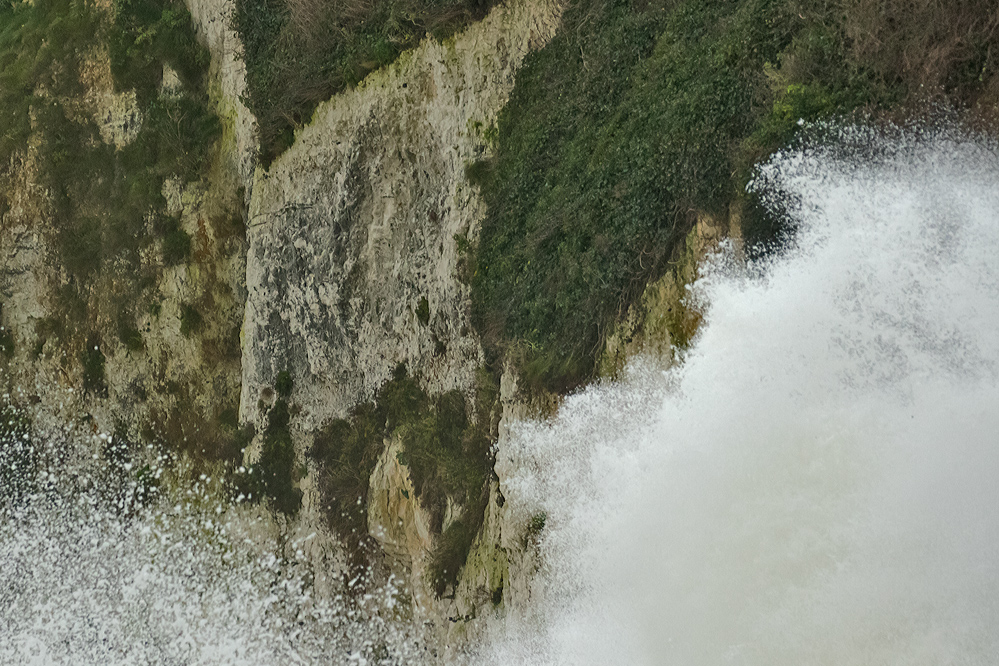
The Bay was a filled with white foam as the waves came in and broke over the wall. After yesterdays tragedy in Kingsdown I was pleased that no one was on the beach taking risks.
The wind, spray and drizzle made a proper sea watch impossible, but I could sea a good number of Fulmars and Kittiwakes over the waves and the occasional Cormorant passing by.
Labels:
Bay,
Black-headed Gull,
Herring Gull,
Pied Wagtail,
Rock Pipit,
sea,
St Margaret's Bay
Saturday, 4 January 2014
More gazing out to sea
The morning started with the disappointment of the scorecard in Sydney, bad even by the standards of this series, but improved as I watched a Green Woodpecker feeding on the grass while I drunk my first cup of tea. Unfortunately it wasn't as cooperative as they often are and spurned the photo shoot opportunity.
At the moment I'm finding the lure of the sea difficult to ignore. Not only is it beautiful to watch but news from near by raised my hopes of finding something our o9f the ordinary. Reports of a Glaucous Gull along the front at Deal and a Black Guillemot passing Dover Harbour had me, once again behind my scope watching the waves.
Of course sea birds aren't the only birds to be seen down there, but I only managed two species (apart from Crows and Jackdaws over the cliff) on dry land. One Pied Wagtail was feeding along the "car park" wall and about ten Rock Pipits were working their way along the shingle. Like most passerine birds, feeding on the ground, it is almost impossible to see the minute morsels of food that attract their attention.
This Rock Pipit hoped onto the breakwater (or is it a groyne?) and peered at the metal structure, before leaping up and picking something off the surface.
I have to say I do have a liking for Rock Pipits. They are hardy creatures, getting their livelihood along the bottom of the cliffs, and just coming together in the bay at high tide when the bay is the only feeding area left.
As the still over-active sea reached the beach it through up a large amount of spray and the surf foamed along the retreating waves. I was in this area that I noticed the flock of Black-headed Gulls feeding attentively amongst the bubbles.
I can only assume that the wave action brings to the surface small items of food that the gulls pick from the foam. Needless to say I didn't find a Black Guillemot or an unusual gull. There were still a lot of Common Guillemots, known as Murres in the USA, and large numbers of Kittiwakes and Fulmars. Again just one Red-throated Diver passed, quite close by and there were also a couple of small groups of Brent Geese flying up The Channel.
Today was FA cup day, but my team (the Gunners was given a bye into the fourth round by the Sp*rs, so there was no competitive game to see this afternoon!
Thursday, 11 November 2010
Can you see what it is Yet?
I had an innocent question from Adam Whitehouse on Kent-birders today "Anything going past on the sea at St Margaret's?" At the time the wind was gusting up to 64 mph and I hadn't been outside the door, preferring to watch the wooden arches that support various climbing plants in the garden, slowly subside into crazy angle form the comfort of my study window.

When the battering reduced to gust of a mere 45mph I did take a look at the sea in the bay. I can't say it was very appealing to me but I did notice a couple of fellows getting ready to take their windsurfers out for a spin. I always thought these guys were mad, now I'm sure!

On the sea wall I notice a small passerine sheltering just behind a Black-headed Gull. At times it flattened itself as if to avoid be blown away by the ferocious wind.

A closer look showed it to be a Rock pipit, a bird seemingly quite equipped to deal with what ever nature throws at it. There can be few birds ion the UK that daily contend with harsher conditions.

The sea was foaming and there were few birds to be seem over the water. One Great Crested Grebe flew past battling into the wind. They look so strange in flight, especially in these conditions, that it took me a few minutes to recognise what I was looking at. In sure a ghostly image came by, hardly visible against the white water. How different to the etangs in the Camargue where I first saw Little Egrets.
Thursday, 1 April 2010
Back on line
After a day and a half with no access to the WEB or e-mail, I'm back on line. The problem seems to have been with a server somewhere but I don't know how many people were affected. It's when you haven't got it that you realise how often you use it! Bird Guides, the Weather, BBC Sports etc etc. So not post yesterday.

The night of Tuesday/Wednesday was wild and windy and "Scar-face" turned up at about 10.30 and quickly demolished his peanuts. Looking well healed I think you can see two puncture marks on the side of his nose. Whether they were caused by teeth or claws I'm not sure.

Over night the wind gathered pace and by mid-day was getting up to a force eight and perhaps even higher out a sea. Down in the Bay the waves were breaking over the railings and throwing up large amounts of shingle.

The spray was sufficient of me not to get too close with the camera. sea water not being very sympathetic to photographic gear, but even from a distance the power of the sea looked pretty awesome.

The Spring tide was pretty high and I think it is the first time that I've seen waves come over the walls at Dover Harbour. The swell in the harbour was sufficient to have the waves breaking over the beach and onto Marine Parade. From Dover I went on to Samphire Hoe where I shared a pleasant half hour chatting over a cup of tea. Finally we made it out into the wild weather and were treated to a pair of Black Redstarts and a cracking male Ring Ouzel that flew up and disappeared into a large bramble bush half way up the Cliff.

"Pretty" face came first last night. It's not difficult to work out that after all the rain "snouting" out worms had been on the agenda before arriving at the peanuts.

While I was looking round the lawn this afternoon, find evidence of Badger feeding, and cursing how fast it was growing since I cut it last week, I was joined by " Donald and Daphne" from the village pond. They seemed to fing the freshly grown grass to their taste but I don't think the two of them cam manage to graze the whole lawn for me.
Wednesday, 17 March 2010
Little Brown Jobs.
Today seemed like the perfect day to find those early migrants that we are all waiting for, a light south-westerly wind and some sunshine. I have to say the wind didn't feel that light along the cliff top.

When I arrived at the edge of the cliff I was surprised to see a Peregrine perched quite close, and although I carefully retreated and crawled to the edge with my camera set up, I was too late and it was away. I had another close encounter later but again I didn't get my camera on it in time.

Further out to sea the visibility was awful and I gave up hope of a decent sea watch.

I take far too many pictures of Fulmars, but I liked this one. Normally I get the underneath when I'm at the bottom of the cliff looking skywards, or the upper-parts when I'm at the top looking down. This picture of the under-parts with the boulders on the beach below seems a little incongruous but it shows just how manoeuvrable they are as they swoop up to a potential nest site.

Meanwhile Dave was out on the big field spraying the grass, for future silage to rid it of chickweed.

My walk was accompanied by a lot of singing, and one of the main vocalists was this Meadow Pipit. As usual I tried to get pictures of it parachuting downwards as it gave the long trill that finishes it's song. Unlike the Skylark the Meadow Pipit is in the air for only a short while, but I just cant get sharp pictures of it while it's up there, my set up just want pick it up and focus quickly enough, I wonder if the EOS 7D would manage it?

All the time several Skylarks were up in the air singing away. With the Meadow Pipit they are in the group of birds often labelled as LBJs. They stay up in the air far a long time and are often more or less stationary, but they are normally very high. So high that I find it difficult to find them and then when I do, even with a 400mm lens they are still just little dots in the sky. Even so the song is really the sound of spring and summer in the open country side. I don't know what song would top the poll as the "peoples favourite". Very Often the Nightingale is elevated to the number one position, but I wonder how many people regularly hear Nightingales, as they are really confined to the south-east, while the Skylark is widespread and although in lower numbers than in years gone by, it is within reach of most people.

Another of my favourite songsters is the Mistle Thrush an a pair were on the field next to the paddock.As is normal they didn't allow close approach. Although not really a "Little Brown Job" they are a bird more often heard than seen. They are also one of the earliest breeders so it is worth watching out for the adults collecting food to take back to their nests.
Saturday, 27 February 2010
Choppy Seas
It was interesting to hear that both Sooty and Manx Shearwaters had been seen at Dungeness today.
The very windy and choppy conditions in the bay made sea watching difficult and in the few minutes that I peered down my telescope, trying to keep out of the spray, I only managed a few Fulmars out at sea. The forecast for tomorrow is awful, but it may be worth having a try if a sheltered spot can be found.
Yesterday, I had a brief but interesting look at Pegwell Bay, unfortunately it was well after high tide but there was a lot of action. At times the flock of Golden Plovers was roosting not too far away, but it was being disturbed by a couple of raptors.
This Marsh Harrier came through, just as I got out of the car, disturbing all the waders in the bay, and shortly after a Peregrine was directly in front of me, swooping down and terrorising the plovers. I didn't see it catch anything, but I had the feeling that it was up to mischief and having fun anyway. By the hide I had a chat to Phil Milton, and we watched a group of four Twite flying over the marsh, but I had missed a Caspian Gull that Phil had seen earlier.
The very windy and choppy conditions in the bay made sea watching difficult and in the few minutes that I peered down my telescope, trying to keep out of the spray, I only managed a few Fulmars out at sea. The forecast for tomorrow is awful, but it may be worth having a try if a sheltered spot can be found.
Yesterday, I had a brief but interesting look at Pegwell Bay, unfortunately it was well after high tide but there was a lot of action. At times the flock of Golden Plovers was roosting not too far away, but it was being disturbed by a couple of raptors.
This Marsh Harrier came through, just as I got out of the car, disturbing all the waders in the bay, and shortly after a Peregrine was directly in front of me, swooping down and terrorising the plovers. I didn't see it catch anything, but I had the feeling that it was up to mischief and having fun anyway. By the hide I had a chat to Phil Milton, and we watched a group of four Twite flying over the marsh, but I had missed a Caspian Gull that Phil had seen earlier.Thursday, 21 January 2010
Under the Cliff
As promised by the Met Office the sun made an appearance this afternoon, but not until nearly three p.m. I popped down for a quick look in the bay and then had a walk along the under-cliff at Kingsdown.


It was high tide and there were several Rock Pipits in the Bay car park, but the visibility was poor and my plans for a sea watch were shelved and I drove round to Kingsdown.

At first I thought that I was going to be unlucky as I couldn't see a Black Redstart in it's normal favoured area around the rocks at the start of the walk. However at the for end this stunning male was flitting around on the sea wall. It didn't stay in view long and disappeared over the wall and presumably carried on feeding along the base of the cliff.

Although the views of Rock Pipits can be much closer in the car park, using the car as a hide there's something more satisfying watching one feeding and calling along the cliff. This one is sitting out on one of the large protruding flints. Later I hope that it will be singing from this spot proclaiming it's territory.

It was a noisy walk, there were a good number of Fulmars establishing their nest sites. The are very vocal and once a pair has settled down they are often visited by an intruder and this starts the noisy cackling off again.

There are a couple of other species in the cliff community. Lots of pigeons, normally described rather disparagingly as Feral Pigeons these cliff dwellers are being true to their genetic heritage and behave very much like Rock Dove would have done before the species became domesticated. Their loud cooing echoes from the sheltered crevices and caves that they inhabit.

Also noisily occupying any vacant sites are Jackdaws, their calls of "Chack" ring out and occasionally the longer drawn out "Chaaiirr" is slightly reminiscent of a Chough. Now that would be a dream come true, Choughs on the Kent cliffs. Perhaps not so fanciful, the last breeding was in 1845, and given that Ravens have returned to breed in Kent after 130 years and Choughs are back in Cornwall it may yet happen.

On the way back to the car I noticed this Black-headed Gull, it must have an early dose of hormones as it is far more advanced in it's summer look that all the others around.

Just off shore this head kept pooping up. There been a Seal in the news lately, after a young Common Seal turned up in a garden in Benenden on Monday morning. It had swum 18 miles up the River Rother to get there. This Common Seal it where it should be and presumably it is an indication that there are some fish out there now.
Subscribe to:
Posts (Atom)