Showing posts with label Spain. Show all posts

Thursday, 30 December 2010

Spanish Flu!

We spent from the 22nd to 29th December in La Linea de la Concepcion. La Linea, as it is generally known is on the main land side of the line that separates the British overseas territory of Gibraltar from Spain.

We left from Luton in snow, and we were lucky that our take off was only delayed by two hours 45 minutes. We were even luckier that our plane landed in Gibraltar as scheduled, all others that day were diverted to Malaga due to high winds, we go in during a short lull. The view from the hotel window over looked on of the marinas and I had lots of views of Yellow-legged Gulls and Shags roosting out in the harbour. The focal point of the trip was Eliot's (our youngest grandson) baptism on Boxing day, but of course we had a great time with Rocio's family with meals on Christmas Eve, and Christmas Day. Unfortunately the last few days were somewhat subdued for me as I developed what I presume was some sort of flu. I got through the Boxing Day formalities, and family party, but then spent much of the last three days in bed asleep.

A large wet area along side the road hosted various birds when I had a look round. There were several Black Redstarts, one of which did pop onto our balcony wall one day, but didn't hang around for long. They seem to be quite common in any open piece of ground in the town.

White Wagtails were also prominent, both in the wet areas and on the roofs of the town buildings.

Of course if you've go Black Redstarts you also have to have an ugly fence for them to perch on!

The rock had hundreds of Yellow-legged Gulls circling the peak. Unfortunately at this time of year they aren't joined but groups of migrating raptors and storks.

Any Larophile can study the various age plumages of Yellow-legged Gulls for the cafe at the top of the cable car.

The views from the top are quite spectacular. I hadn't really appreciated quite how much development there is on Gibraltar until we were able to look down from the top.

The runway juts out into the sea on both sides of the rock. Behind it you can see the marina and our hotel.

You can't go to Gibraltar without going to see the Barbary Macaques. It is the only population of these monkeys on mainland Europe. There is a population of about 230 animals in five troupes. As they are a tailless species, they are also known locally as Barbary Apes or Rock Apes, despite the fact that they are monkeys (Macaca sylvanus).
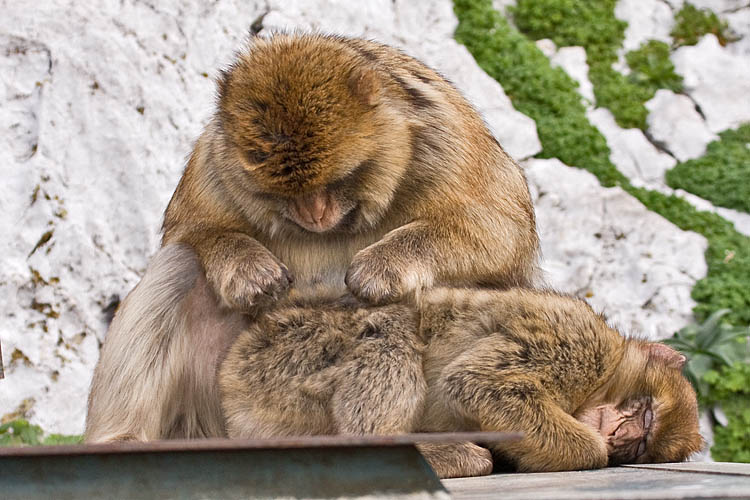
Like all monkeys grooming plays a major part in their social activities. They are of course habituated to people and this leads some people to act very stupidly, despite the warnings. They can be quite viscous and will inflict nasty bites.
All Gibraltar Barbary Macaques are descended from North African populations of Barbary Macaques. DNA evidence has established beyond doubt that the present population of Gibraltar macaques is of relatively recent Algerian and Moroccan origin. No traces were found of a third source for their DNA, namely of any ancient, no longer surviving Iberian population. An earlier theory, now dis-proven by the DNA evidence, was that the original Gibraltar macaques were a remnant of populations that had spread throughout Southern Europe during the Pliocene, up to 5.5 million years ago.
The original introduction of the macaques was probably by the Moors (who occupied southern Iberia, including Spain and Portugal, between 711 and 1492) for use as pets.

Tuesday, 24 February 2009

A Spanish lark.

One of the good things about birding in southern Spain is the opportunity to see a greater diversity in families that we have grown up with here. The larks are an example, for although they don't reach the number of species that occur in Southern Africa there is a chance to see six species at this time of year and a seventh in summer, with in easy reach of Alcala de Los Gazules, and another more towards central Spain. Mind you this one's the easy to hear (if you're in the right place) but notoriously difficult to see Dupont's Lark. Steve Rowland, ex-Kent birder, has an account of his encounter with this bird on his "Bull of the Bog" blog.

This small, almost Sparrow like Lark goes by the uninspired name of Lesser Short-toed Lark. We found it in the area of the Marshes along the east bank Rio Guadalquivir, where it appeared quite common. Apart from a few in Portugal all the western European population is in Spain. The far side of the river borders the Coto Donana, made famous in the UK by the book, Portrait of a Wilderness by Guy Mountford featuring Eric Hoskins photographs. The larger relative of this Lark, the Short-toed Lark arrives to breed in the summer.

One Lark that I was pleased to see was the Thekla Lark. This bird is similar to the Crested Lark, which I'm much more familiar with as it occurs round the car park in Calais. The Thekla Lark, in often occurs on higher, rockier slopes, although is some areas it does inhabit steppe areas and coastal dunes. It had a stouter bill than the crested Lark and heavier streaking on the breast. Jack thinks, and he might be right, that the crest is more untidy and "punkier" than on the Crested.

This Crested Lark seemed to enjoy a charmed life. It was searching a busy road for items of food. I watched avoiding the traffic while we supped our morning coffee (great coffee too, no British Railways dish-water here!). The Crested Lark gets right up to the French coast but seems reluctant to cross over, a shame because there's lots of suitable habitat for it over here.

Can't leave out the Woodlark, in the UK it enjoys a restricted range and it is always pleasant diversion to hear one singing. Over much of its range it is far more common and in many places its song is a familiar background sound, along with the Nightingale and song Thrush. This one nicely shows the black and white alula area and the well marked supercilium.

On La Handa we watched the sun go down and as we did a recently arrived flock of around 50 Black Kites flew through, lazily flapping, presumably off to a nearby roost.

Friday, 20 February 2009

Just like St Margaret's?

Although it is only mid-February several migrant species were already in evidence in the South of Spain. There was a continual stream of Swallows and lesser numbers of House, Crag and Sand Martins. Below are a few photos from day 2 of our trip (Saturday 14th Feb).

This and the next two species have all been seen at St Margaret's in the last few years, but of course they are strays when they get here, but at home in Spain. We saw a few Black Storks, including one coming in off the sea, a strange sight, as you are looking for Shearwaters!

There were a few Black Kites about at the beginning of the week, but by the last day they were more numerous, when we counted 111, including one group of over 60.

White Storks were numerous, this one had a white ring on that read C WP. I don't know if it is to do with how they feed, but many White Storks look grubby, with just a few pristine black and white.

There were quite a few of these orchids in the Stone Pine wood at Barbate. Thanks to Dave Johnson I now know that these are Sawfly Orchids (Ophrys tenthredinifera). They're not Early Spiders, but it is still a reminder of the orchids of our area.


The sunset from the balcony of John's house is still fantastic, but the view is slowly changing, with large wind generators beginning to come into view on the left. It was 21 months since I was last in the area and the number of these intrusive monsters in the area has increased hugely. Mind you, if the ones at East Langdon get planning permission the evening view from our top windows will include some of these horrors.

Thursday, 19 February 2009

Return from Spain.

Just in from Spain, so I haven't sorted many pictures yet, just a few from the first morning.

Near the top of my list was the desire to see White-headed ducks in breeding plumage close to, and John obliged with a really good site. This bird was "steaming" towards another male.

It really got up a full head of steam as it chased it across a small pool.

Slender-billed Gulls are among the most elegant of the European gulls and at Bonanza we got excellent views of around 100 birds.

Wednesday, 11 February 2009

A week in Spain

Tomorrow morning Jack Chantler, John Cantelo and yours truly are off to John's Spanish pad for a weeks birding, a report will follow at the end of next week

John's House

Lesser Kestrels should be back (they nest in the wall of the building).

View from the balcony

Pictures from May 2007

Sunday, 17 June 2007

Spain - Alcalá de los Gazules Elections update

You may remember the picture of the election candidate in de Alcalá de los Gazules when we were on holiday. Pam just found her election leaflet in our luggage and I looked up on the WEB how she got on. I know nothing of the politics but she only got 26 votes out of 3333 cast, that's 0.78%. If she'd used my picture instead of this one she might have got to 30 votes!

Saturday, 19 May 2007

Spain 18th May 2007 Alcala and Laguna de Medina

This is one of the candidates for the local election in Alcala. She should have let me do her photo for the poster she was handing out, it was a poor picture. Her name is Clara Cairon Quesada.

John and Liz's house in Alcala de Los Guzales. You can see the wall of the roof terrance, where you can sit and contemplate the world in the warm sunshine.

One of the last ports of call was the Laguna del Taraje, where we saw this small group of Collared Praticoles with a Little Ringed Plover.

There are more pictures of Southern Spain on my flickr account

Spain 17th May 2007 Medina-Sidonia and Bolonia

Plaza de España -with the Town Hall. We thought Medina-Sidonia the most elegant of the Andalusian towns we visited.

Santa Maria la Coronado Church

Santa Maria la Coronado Church - Built on the foundations of the original castle and later a mosque, this church is a fine example of Andalusian Gothic architecture. Inside there is an enormous 15m high and exquisite retablo, that typically depicts scenes from the life of Christ.
May 17th is our Wedding Anniversary and after 42 years we're still married, not a record, but somewhat unusual in the current matrimonial climate. Today we were to go and see the Roman Ruins at Bolonia, but Pam slipped on the pavement near this church and fell on her knee and ankle. We still went to Bolonia, but not to the ruins.

One of the Moorish Gates.


The sheep equivalent of hiding your head in the sand. In this case getting out of the sun.

Spotless Starlings are common here and replace the Common Starling of Northern Europe.


A Pair of (Barn) Swallows have made this restaurant their summer residence. We had a great meal at this resturant, Sea Bream, and got a bag of ice to wrap round Pam's ankle!


Look what I've got the Kids for dinner!


Black-eared Wheatear by the Roman ruins.


Woodchat Shrike.
On the way back to the house, we popped into a bar in Alcala to celebrate with a bottle of red. On the way out we met one of the candidates for the local elections and had a sort of sign language chat. The local elections are why I hardly got a picture in a town without a poster in it!

Spain 16th May 2007 Barbate and Cape Trafalgar

We started the day by visiting the Emblase de Barbate again, because I'd seen a Ruddy Shelduck there on the first visit and wanted to photograph it, once I realised that it could be rare for Spain, if it is a genuine wild bird.

It certainly didn't allow close approach and quickly flew off, towards the rice fields when it stuck my head over the bank I was approaching behind.

Along the coast, between Barbate and Cape Trafalgar there is an extensive area of pines, that are open to the public. The common Sardinian Warbler noisly announced its presence everywhere and we watched a pair of Spotted Flycatchers here. This was once a common species in Kent but numbers have drastically declined.

At Cape trafalgar I was fascinated by the skill of the Kite-surfers, and I was jealous, how I wish I was young and fit enough to do it!

The girl at the back is just at the beginning of an atheletic jump, but she didn't regain her balance and continue the run.

While we were here a continuous stream of Honey Buzzards were arriving. They cross the sea a the narrow strait between Morocco and Spain on their way north to breed.

Various waders were in the pools behind the beach, this is a kentish Plover.

This group consists of Dunlin, Ringed Plovers and kentish Plovers.
This Yellow-legged Gull had just acquired a eel, but it failed to make a meal of it.

Two Black-winged Stilts were on the beach.

While I was photoing the Stilts four Whimbrel flew in

Whimbrel

Crested Larks were plentiful in the beach area.

Resting Yellow-legged Gulls.

The town of Vejer de la Frontera is on of the most "Moorish" of the southern Spanish towns.

The Church at Vejer.


The White Storks nest on the church at Cantarranas is the image that most people have of White Sorks in Spain.


The nest here was multipurpose. Storks on top, and then House Sparrows and Spotless Starlings as tennants.